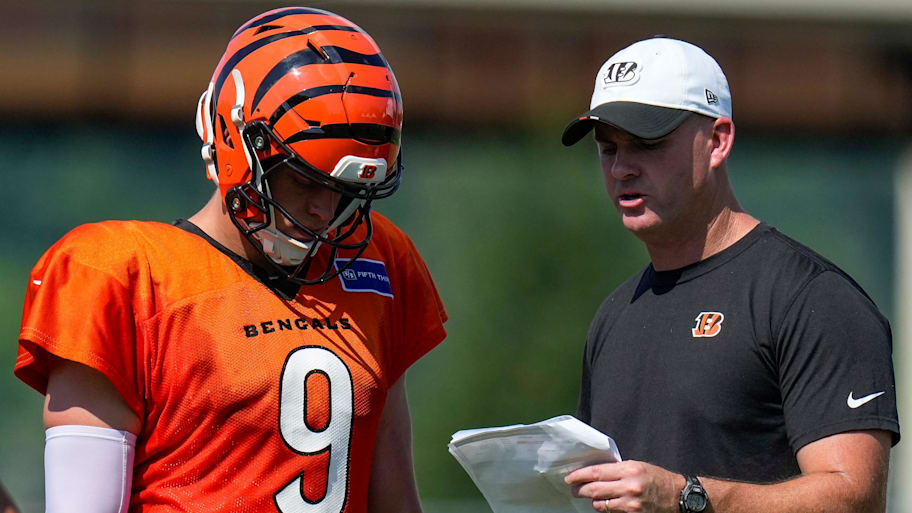
After Sunday’s loss to the Ravens, Bengals quarterback Joe Burrow was about as despondent as we’ve ever seen him, noting straight-faced that no team in the NFL would have won a game with him playing quarterback the way he did that day. This followed an introspective birthday press conference earlier in the week in which Burrow talked about how much work goes into football, and that if it stopped being fun, he would fail to see the point.
Burrow, in that press conference, admitted to some difficulties both at work and personally.
And while this could just be a funk—one we should respect him for being so honest about, first and foremost—when the most important player in an organization is not happy, that normally sets off an alarm bell that may or may not lead to some sort of corrective action. Not every team has a hulking consigliere like Big Dom DiSandro, who can pluck a malcontent off the field in the middle of practice and deliver him to ownership for an ironing out.
But when it comes to Burrow specifically, it would seem like Cincinnati is running out of ways to pacify him. The Bengals have already made serious upgrades to their facilities, scouting department and roster since Burrow arrived (and you can argue that perhaps there is a difference between aggression and finding the right players, but you cannot make the argument that the Bengals have stood pat when it comes to protecting Burrow). The team signed two of his three top receivers to top-of-market extensions. In an effort to make a serious playoff push, the Bengals solved arduous negotiations with both Trey Hendrickson and Shemar Stewart. The team brought in a new defensive coordinator before the 2025 season. The team sold the naming rights to its stadium to generate additional revenue.
To fall back on the default, that Bengals ownership doesn’t care and that this is a similar narrative to what swirled around the hardened and cynical Carson Palmer, is incorrect.
That said, at parallel press conferences the past few weeks, Burrow’s head coach, Zac Taylor, has also been asked either directly or indirectly about his own feelings related to job security. His contract expires after the 2026 season. With the Bengals now 4–10, this is his first losing campaign in Cincinnati since 2020, though a pair of 9–8 seasons left the Bengals out of the playoffs the past two years. If we’re talking about one final lever for the Bengals to pull and shake up the organization, making a change at the head coaching position would certainly be it.
As to the question of whether Cincinnati would actually do it—that remains a more complicated proposition.
In surveying the league’s coaching landscape for my latest future head coaches list, the sentiment around the Bengals’ job, at least according to those whose vocation is to anticipate jobs that may come available, was that firing Taylor after this season would seem out of character for the organization. However—and this is the important factor to consider—if the Bengals’ job were to open and the chance to work with Burrow came available, it would significantly alter the coaching market and likely draw any and all top candidates. Cincinnati would be seated at the power position.
Coaches coming into the head job are realistic that every opportunity comes with a massive, double-alarm, surgeon general’s warning. Maybe the owner is meddlesome. Maybe the general manager has the tenure of a woefully ineffective college philosophy professor. Maybe the roster is in decline. Most coaches are confident enough to believe they can navigate these hurdles, or want the job so badly that they’re willing to gloss over them.
A job with a quarterback like Burrow, though, is a true no-brainer. Burrow is one of five quarterbacks in the NFL who could single-handedly alter the course of a game. He is 29, still well within his athletic prime, and his contract is now on the decline in terms of the percentage it takes up relative to the total salary cap, after reaching its peak in 2025. Having someone like him is the quickest path to immediate success.
Now, this is a strange and fascinating season to be in need, given this head coaching market. Nearly all the top candidates are on the defensive side of the ball. Rising offensive coaches who would prove schematic equals for Burrow are in short supply and the next crop are in need of seasoning. Most—Declan Doyle, Grant Udinski and Davis Webb—are roughly Burrow’s age. Klint Kubiak, the Seahawks’ play-caller, is one of a few exceptions, though there’s a chance he needs a little more experience as well before stepping into the limelight. (You can read more about all these candidates on my full future coaches list.) In some ways, it feels like this nadir is coming a year late, with Ben Johnson, Liam Coen and Kellen Moore already a year into their head coaching tenures.
I purposely left out Bills OC Joe Brady, who was Burrow’s offensive coordinator at LSU, from the paragraph above in order to devote a little more space. While coaching Josh Allen is another excellent gig, Brady has done some of the complicated work, installing a run game and dependable short-range passing game that works uniquely with Allen’s cowboy-esque point guard playing style. I also left out Broncos DC Vance Joseph, who coached for the Bengals in 2014 and ’15, and is familiar with the Brown family. Joseph has been one of the league’s best defensive coordinators for half a decade now and may be attractive as both a candidate with high-level emotional intelligence and the ability to mold a coherent defense out of almost any pieces (the Bengals, since 2019, have been the 27th-best defense in the NFL by EPA per play, notoriously taking on an infamous role in turning some of Burrow’s best offensive performances into losses).
In my own personal estimation, if Cincinnati were to make a change, it would be because the team felt like it may miss out on a chance at coaches like these in particular, who may not be available the following season. Joseph represents the peak of one very desired archetype this cycle: a CEO coach with previous experience who can expertly command one side of the ball. Brady, the other: an accomplished play-caller with a track record of working with a high-I.Q. passer. Both will be requested by most, if not all, teams with openings. The offensive coaching pipeline probably won’t improve much over the course of a year, either.
Let’s pivot to Taylor. Since 2019, the Bengals have had the 14th-best offense in the NFL by EPA. Since 2021, the Bengals’ offense has posted a higher EPA per play than the Rams on average, as well as a higher dropback success rate (though L.A.’s run game is the ultimate leveler and the Rams defeated the Bengals in Super Bowl LVI). There’s a chance, as I’ve noted with other “hot seat” names such as Mike McDaniel and Kevin Stefanski, that Taylor would receive interest for other vacancies if he were let go due to the lack of experienced high-level play-callers on the market.
Part of the reason he so quickly endeared himself to the Bengals’ job was his affinity for the area (Taylor was the offensive coordinator of the Cincinnati Bearcats before joining Sean McVay’s staff in 2017). Taylor went into the Bengals’ job with a laser-focused intention of securing that job in particular, based in part around his desire to raise a family there. Taylor’s run to the Super Bowl in the 2021 season was transformative to the area and bought him a good deal of emotional equity.
In short, there is—or at least was—a great deal of mortar holding together this relationship.
Which brings us, finally, back to the quarterback.
If Burrow’s discontent is related to the head coaching position, then it makes sense to explore other options, knowing that he is the biggest singular draw of this cycle. If Burrow is experiencing something similar to Andrew Luck (meaning the totality of mounting bodily harm and losses translating to a kind of NFL-specific melancholy) then it only matters how he’s supported during this time.
It’s worth noting that some of Mike Brown’s best hires were considered, at the time, out of character. Marvin Lewis, for example, came from a division rival and was brought in with the ability to fundamentally change the organization’s culture and modus operandi. Many of the decisions Brown has made since are to ensure that Burrow doesn’t reach the point where rescuing his hometown Bengals doesn’t seem like a fairytale worth chasing anymore.
If we’re truly at that point, character or precedent mean next to nothing. Especially when, for the hiring cycle that I can remember, all eyes are on Cincinnati.
More NFL From Sports Illustrated
This article was originally published on www.si.com as With the Coach Carousel Spinning, All Eyes Are on the Bengals.