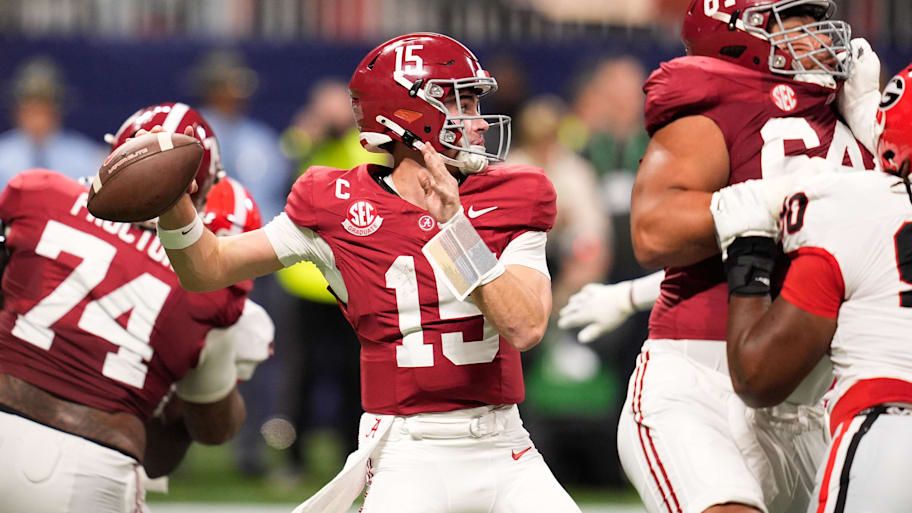
College football is the greatest sport in the world and also the dumbest sport in the world, a dichotomy that keeps it entertainingly maddening. It is incredibly compelling and passionate, yet it is constructed in such a flawed way that criticism is a constant byproduct. It’s a hot mess, and rarely has it been hotter or messier than right now.
Ratings are up. Outrage is up. Both those dynamics will continue to surge after the 12-team College Football Playoff bracket was revealed Sunday.
THE STAGE IS SET 🏆 pic.twitter.com/RJNdAkzrcE
— Sports Illustrated (@SInow) December 7, 2025
The selection committee had an excruciating decision to make with three teams: Alabama, Notre Dame, Miami … someone had to go. The result was mostly logical—Alabama and Miami in, Notre Dame out—but it was guaranteed to be intensely controversial. The committee exacerbated the situation by repeatedly beating itself in the head with a hammer on its self-defeating weekly ESPN TV show, so that by Selection Sunday fan cynicism was peaking. Nothing like showing up at your art gallery grand opening with two black eyes.
In the end, the 10–2 Hurricanes deserved the nod over the 10–2 Fighting Irish based on head-to-head result—that had to matter. Alabama’s inclusion—and complete free pass after being pummeled by Georgia in the Southeastern Conference title game—is the less defensible decision. The committee took care of the Crimson Tide to a remarkable degree in its last two rankings, strangely moving them up a spot to No. 9 after a sluggish victory over 5–7 Auburn, and then not dropping them at all following the 21-point loss to the Bulldogs.
In fact, the SEC championship game might as well have not been played. Despite the emphatic result, Georgia did not move up from its No. 3 spot and Alabama did not move down. It was a meeting that could have been an email. But thanks for attending and spending all that money, everyone.
The Big 12 championship game, which BYU lost by 24 points to Texas Tech, mattered for the Cougars—they were jettisoned from consideration for an at-large berth. That made sense, but it also triggered the ridiculously wonky protocol by which Miami moved past Notre Dame with neither team playing.
The committee’s tedious ranking process involves evaluating teams in groups of four, scrubbing their résumés and moving them up and down in relation to each other. Miami and Notre Dame were far enough apart in the rankings that their résumés weren’t compared until the latter stages of the month-plus process.
Here’s the problem: Last week, when Notre Dame was No. 10 and Miami was No. 12, the head-to-head result was not a determining factor. But No. 11 BYU’s loss removed the only buffer between them, and then suddenly the game on Sept. 1 did matter.
It should have mattered more last week than it did. And probably in the previous weeks as well. Retrofitting that result into the most crucial decision of the entire playoff releases a fresh backlash, as college sports was once again left trying to explain its arcane self to a public that just wants it all to make sense.
Miami was frustrated in previous weeks when the game against Notre Dame was downplayed. The Fighting Irish are frustrated now, after their dominant 10-game winning streak was brushed aside. Just about everyone was frustrated at some point as the weekly rankings came out and the committee chairmen flailed to explain what was happening.
It probably didn’t make a difference, but remember that both Alabama and Miami were left squawking on the outside last year—the Tide was the first team out, the Canes were the second. Both those decisions were correct, but the dismay from both fan bases would have been amplified if it happened two years in a row.
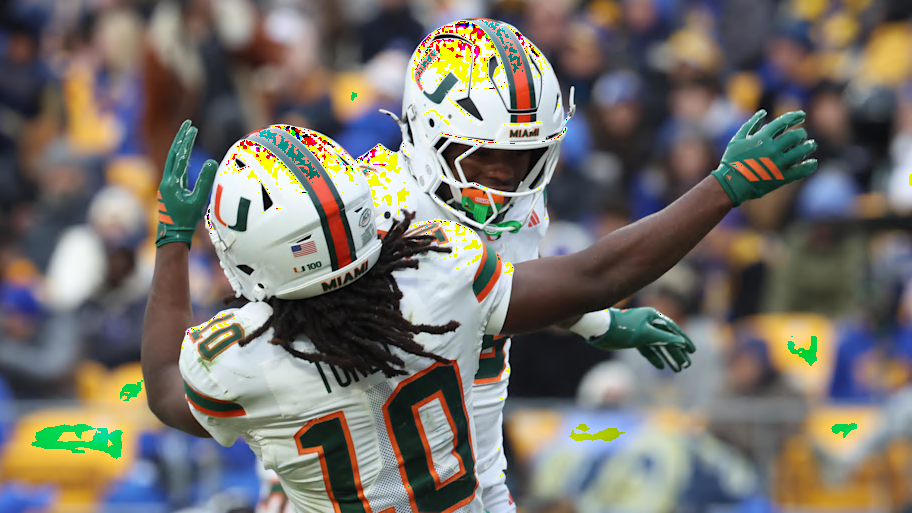
Ultimately, Notre Dame failed to control its own destiny. Its penchant for slow season starts under Marcus Freeman was fatal this time, opening with losses to Miami and Texas A&M by a total of four points. It’s amazing to consider that close losses to playoff teams were more costly than the humiliating September home loss to North Illinois last year, which Notre Dame overcame to make the field. A play as simple as an extra point looms over the entire season, after a botched hold on the Irish’s final touchdown against A&M became the margin of defeat.
Beyond the three teams that were at the center of debate, here are the biggest winners and losers from Selection Sunday.
Winner: The sport as a whole, which has more fluidity and upward mobility than ever.
Indiana, a certified football miracle, is the No. 1 seed. First-time playoff contestants comprise half the bracket—No. 4 seed Texas Tech, No. 6 Mississippi, No. 7 Texas A&M, No. 10 Miami, No. 11 Tulane and No. 12 James Madison. Not only are they new to the playoff, but only the Hurricanes have won an FBS national title this century (2001). Everyone should have hope. It can be done.
Winner and loser: The ACC
The ACC was bailed out by the inclusion of Miami in the last at-large spot. That compensates for a poor overall season and a flawed tiebreaker procedure that left the Hurricanes out of the league title game despite clearly being the best team in the league. With 8–5 Duke winning the championship game, the ACC was perilously close to the embarrassment of being a Power 4 conference with no playoff bid.
Winner: The state of Texas
The state puts two teams in the bracket for the second straight year—and they’re different teams from last year (Texas and SMU). The state that arguably loves football the most now has had five schools make the playoff in the last four seasons, with TCU making the championship game in 2022.
Loser: Texas
The Longhorns will watch their two biggest rivals compete in the playoff, Oklahoma and Texas A&M, and eternal little brother Texas Tech. After starting the season No. 1, it’s been a humbling season. (If Texas is capable of being humbled.)
Winner: The Rose Bowl
“The Granddaddy of Them All” will get the Story of the Year—maybe the Story of Forever—in Indiana against a blueblood SEC team in either Alabama or Oklahoma. The sight of Hoosiers fans in Pasadena on New Year’s Day, something not seen since Jan. 1, 1968, will be something.
Loser: Fans of fresh matchups
There are two regular-season rematches in the first round—Alabama vs. Oklahoma (which was a slog) and Tulane vs. Mississippi (which was a blowout). If the Rebels beat the Green Wave, they’ll have a rematch with Georgia in the Sugar Bowl quarterfinals.
It will take a month from the first playoff game to the last, so settle in. Hopefully the complaining will die down quickly. The sport has many flaws of its own making, but the current 12-team playoff ranks far down that list. Some hot messes don’t need to be fixed.
More College Football from Sports Illustrated
Listen to SI’s new college sports podcast, Others Receiving Votes, below or on Apple and Spotify. Watch the show on SI’s YouTube channel.
This article was originally published on www.si.com as How Alabama’s College Football Playoff Gift Exposed the Committee’s Worst Flaws.